CT scan
A CT scan provides detailed images of the body’s bones, organs and tissues. The examination can be used, among other things, to examine bone changes, kidney stones, inflammatory conditions, haemorrhages and diseases of the body’s internal organs.
At CPH Privathospital you are always examined by experienced radiographers and consultant radiologists. We ensure that we inform and guide you through the entire examination, so you know what will happen.
What is a CT scan?
A CT scan is a computer-controlled X-ray examination. CT stands for Computed Tomography.
During the examination, a series of images are taken from different angles. A computer combines the images so that the body’s bones, organs and tissues can be examined in detail and viewed from multiple angles.
The images are subsequently assessed and described by our consultant radiologist.
What can a CT scan be used for?
A CT scan can be used to examine many different parts of the body. At CPH Privathospital we offer, among other things, CT scans of:
- The brain
- The sinuses
- Lungs and chest
- Abdomen and abdominal cavity
- Spine and neck
- Pelvis
- Bones
- Kidneys and urinary tract
A CT scan can be used, among other things, in cases of suspected complicated bone fractures, bone changes, kidney stones, inflammatory conditions, haemorrhages and tumours.
It is your doctor and our specialists who assess which examination is relevant for you.
How is a CT scan performed?
Before the examination, one of our radiographers will inform you and guide you, so you know what will happen.
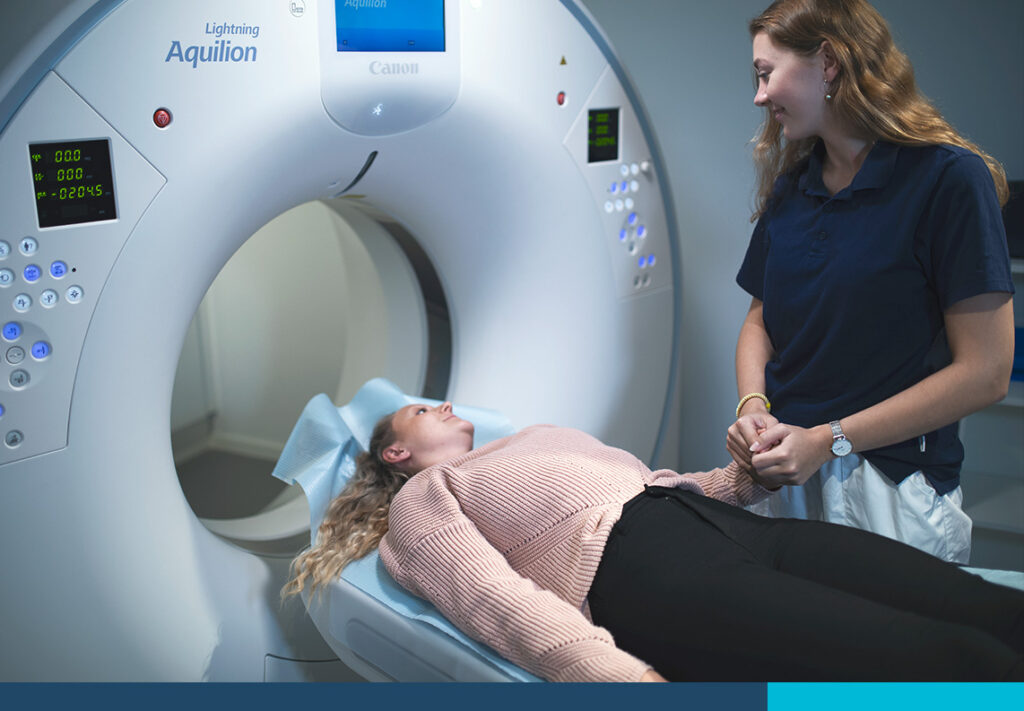
During the CT scan itself, you lie on your back on a table that moves through the scanner’s opening. Depending on which area is to be examined, you may be asked to place your arms above your head.
Most of your body will be outside the scanner. We help you to lie comfortably, making it easier to lie still while the images are taken.
During the procedure you may be asked to hold your breath briefly. It is important to follow the radiographer’s instructions so that the images are as clear as possible.
The scan itself typically takes between 5 and 20 minutes.
Preparation before the examination
Before the examination you will receive information on how to prepare for your specific examination.
As a general rule, you can eat, drink and take your usual medication as normal, unless otherwise stated in your appointment letter or you have received other instructions from your doctor.
We recommend that you arrive in comfortable clothing. Metal objects in clothing or on the body can in some cases interfere with the images. You may therefore be asked to remove jewellery, watches and other metal objects before the examination.
IMPORTANT! Always follow the specific instructions you receive from us.
CT scan with contrast medium
For some CT scans, an iodine-based contrast medium is used, which makes it easier to distinguish between the body’s organs, blood vessels and tissues.
The contrast medium is normally given through a thin needle in a vein in the arm. When the contrast medium is administered, you may briefly experience a feeling of warmth in the body or an unusual taste in the mouth. This is common and disappears quickly.
If your examination requires contrast medium, we may need a blood test showing your kidney function. You will receive further information about this before the examination.
It is important that you tell us if you have previously reacted to contrast medium, have reduced kidney function or have other diseases that may be relevant to the examination.
After the examination you may be asked to wait in the department for a short period.
Can everyone have a CT scan?
The vast majority of people can have a CT scan. However, there may be circumstances that require special attention.
Always tell us before the examination:
- If you are or may be pregnant
- If you have difficulty lying flat and still
- If you have previously reacted to contrast medium
- If you have reduced kidney function or other relevant diseases
A CT scanner has a relatively wide and short opening, and most of the body will typically be outside the scanner. If you are anxious about the examination or have claustrophobia, you are welcome to contact us in advance. Then we can talk to you about the procedure and your options.
X-ray radiation during CT scan
A CT scanner uses X-rays to create images of the body. The radiation dose depends on which area is to be examined and what type of examination is needed.
The examination is planned so that the necessary and lowest possible radiation dose is used, while ensuring that the images have the quality required to make an accurate diagnosis.
Your doctor and our specialists always assess the relevance of the examination in relation to the radiation you are exposed to.
Referral for CT scan
You must have a referral from a doctor to have a CT scan.
If one of the consultants at CPH Privathospital assesses that you need a CT scan as part of your treatment pathway, the doctor can refer you directly.
The referral contains the information that our specialists need to plan the right examination. It also tells us who the result should be sent to.
When will you receive the result?
After the examination, the images are assessed and described by a consultant radiologist.
The result is sent to the doctor who referred you. It is the referring doctor who reviews the result with you and discusses the further treatment pathway with you.
Price for CT scan
The price depends on which area is to be examined and whether contrast medium is needed.
See our current prices for CT scans.
Contact and appointment booking
If you have questions about the examination or wish to book an appointment, you are welcome to contact CPH Privathospital.
Telephone: +45 70 21 80 00
Email: info@cph-privathospital.dk